All Things You Shoulod Learn for 3d Dimensional Art
When young children create visual fine art, they explore and experiment with the backdrop of materials. Some classic examples of developmentally appropriate fine art opportunities for children include drawing with crayons, painting at an easel, or creating a paper collage. These types of art experiences allow children the opportunity to explore in two dimensions of infinite.
Through these experiences, children express their ideas and develop an agreement of the various elements of design including line, shape, and color. Children develop fine motor coordination with their easily, develop their ability to focus on a job and share their ideas through both their artwork and conversations nearly their creations.
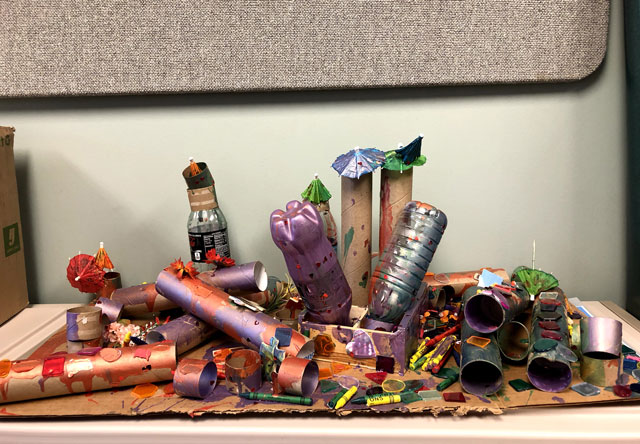
Young artists tin can as well work with three-dimensional (3-D) media. Adding a third dimension of physical space allows young artists to explore design backdrop in new ways. Three dimensional materials allow children to design with length, width, and depth. Working in three dimensions provides new challenges for young artists. For instance, when children create in three-D, they must cull the well-nigh appropriate media for their purpose, residual the objects in their creations, and problem-solve how to attach materials.
Neighborhood walks can exist a slap-up source of inspiration to children as they notice 3-D forms. They take likely encountered statues and sculptural elements in the built environment and natural forms in the rocks, trees, and other plants in their surroundings. Observing these forms can be a springboard for their three-D creations.
When early on childhood teachers and caregivers seek to move from making product-oriented "crafts" to more procedure-focused art opportunities, it helps to brainstorm simply. For instance, ane might provide children with tempera paint and kitchen tools such as spoons, murphy mashers, and forks and allow them to observe the possibility of painting with objects other than brushes.
Similarly, it helps to start modest with 3-D materials. Children can be provided with flexible wire and wooden beads so they tin can figure out what types of shapes they can create and how the position of the beads might change if the wire is bent in dissimilar directions. They might be given dirt or playdough with wooden sticks and effigy out how to attach the ii to build structures.
Teachers and caregivers tin actively scaffold children'southward thinking and experimentation by modeling how the materials might piece of work together, commenting on children'due south tries at using the materials, and providing children multiple opportunities with a gear up of materials to develop their familiarity and skill in using these materials. You may be surprised by what you can create!
New techniques such as sewing and lacing fabric, bending and forming shapes with wire, or working in clay can be introduced equally children become familiar with creating in iii-D. The process of creation should be the focus of the activity rather than the consequence, just as it is with paintings, drawings, and other 2-dimensional creations. It is possible for children to create objects with a specific purpose in mind, such as a costume that can be worn during dramatic play or a representation of a building they take observed. Still, it is non necessary that a product be planned. Children can be given materials that they can experiment with in three dimensions, and, through the procedure of trial and error, they can become familiar with their properties and detect the possibilities of what they tin create.
Related IEL Resources
- Resource List: Explore the Arts with Young Children
- Resource List: Explore STEAM with Immature Children
- Blog: Make Art a Part of Every Day: Focus on the Procedure
 Rebecca Swartz

Post a Comment for "All Things You Shoulod Learn for 3d Dimensional Art"